Short answer
Ask any outbreak disinfection vendor which registered product they will use and whether its label covers your organism, how they will achieve the labeled contact time, how they clean before disinfecting, what training and protection their staff have, how they treat electronics and soft goods, what re-entry guidance applies, and what the final report includes. Specific, verifiable answers are the best sign of a qualified company.
Why an outbreak vendor needs more scrutiny than a janitorial contract
Your regular janitorial provider is chosen for consistency and cost across months of routine work. An outbreak vendor is chosen under pressure, often in a single afternoon, for a job where parents, patients, members, or employees will ask afterward what was done. The stakes and the scrutiny are different.
The disinfection market also grew quickly in recent years, and not every company that bought a sprayer has the product knowledge to match. A handful of well-chosen questions will quickly show you whether a vendor understands organisms, labels, and contact times, or is selling a generic service with a new name.
The ten questions below are grouped by theme. You can ask them on a single call or send them by email and compare written answers side by side.
If you have an infection control lead, school nurse, or occupational health contact, ask them to listen in on at least one call. They will often catch a weak answer about product claims or contact time faster than an operations manager can, and their involvement makes the final decision easier to defend.
Questions 1 and 2: the product and its registration
Question 1: What product will you use, and what is its EPA registration number? This is the foundation of everything else. EPA explained in 2025 that under FIFRA, a disinfectant must be registered with EPA before it can be sold or distributed in the U.S., and that more than 4,000 antimicrobial products are currently registered. The registration number lets you look up the label yourself.
Question 2: Does the label list the specific organism we are dealing with, and on which surfaces? Products are not interchangeable. A label may cover influenza but not norovirus, or hard nonporous surfaces but not soft ones. For certain organisms, EPA maintains separate lists of qualifying products. Ask the vendor to point to the line on the label that supports their choice.
A vendor who answers with phrases like hospital grade or kills 99.9% of germs, without naming the product, has not answered the question.
Questions 3 and 4: contact time and pre-cleaning
Question 3: What is the labeled contact time, and how will your crew make sure surfaces stay wet that long? The answer should be concrete. For example, the vendor might describe how they reapply on vertical surfaces, how they sequence rooms so product does not dry early, and how supervisors check.
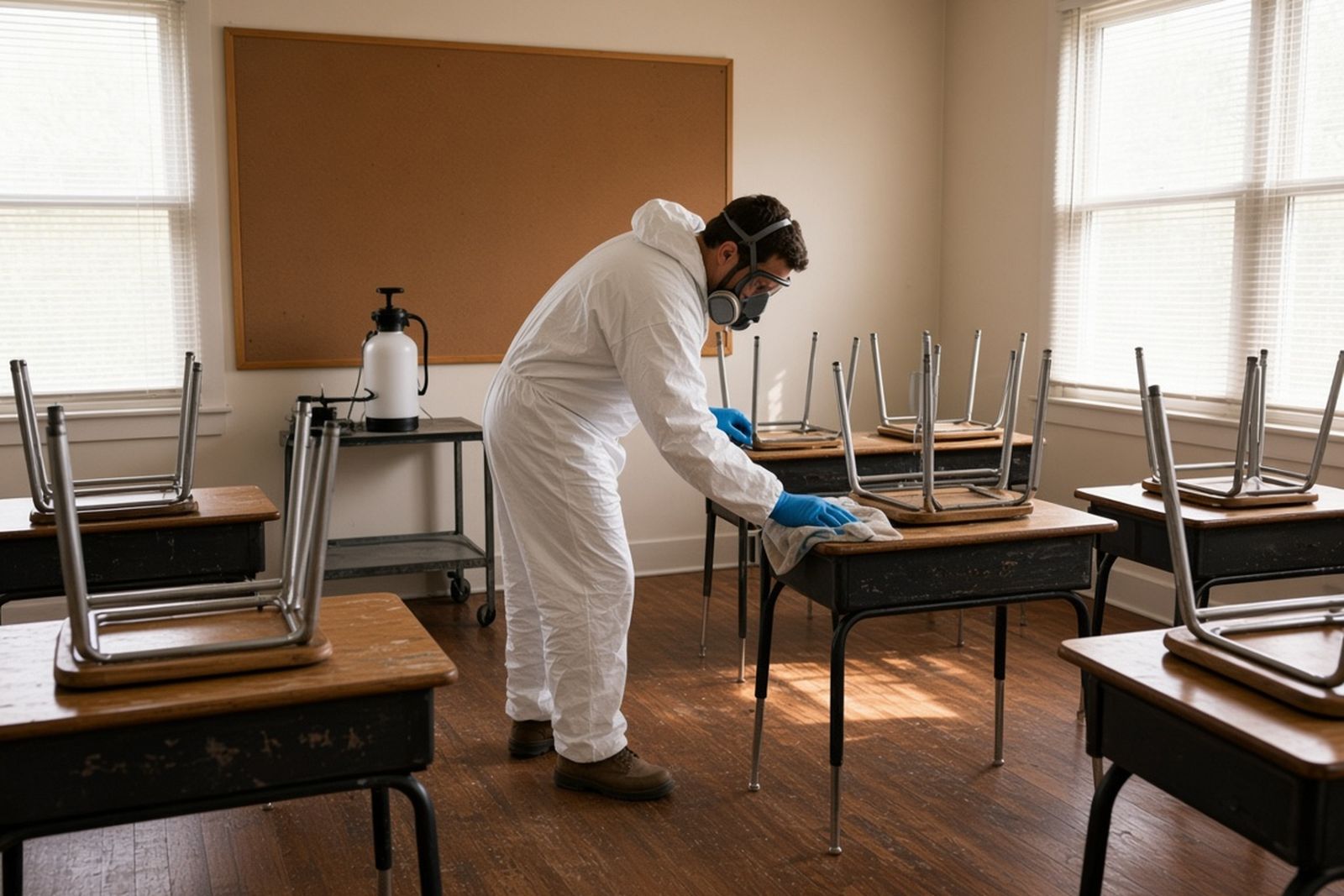
Question 4: What cleaning happens before disinfection? Soil, body fluids, and residue can shield microbes from the chemical. Many labels require pre-cleaning of heavily soiled surfaces. A vendor who plans to spray without cleaning first may deliver a building that smells of disinfectant but still carries contamination on the surfaces that matter.
These two questions often reveal the difference between a vendor who understands disinfection chemistry and one who relies mainly on equipment.
Questions 5 and 6: how are your technicians trained and protected?
Question 5: What training have your technicians had on the products and methods they will use in our building? Look for training on label reading, contact times, protective equipment, and chemical safety. Ask whether the technicians who will be on your site are employees or subcontractors, and who supervises them.
Question 6: Do you maintain a bloodborne pathogens program if your work may involve blood or body fluids? This matters in clinics, group homes, gyms, and schools where injuries happen. OSHA's Bloodborne Pathogens standard requires employers with exposed workers to keep a written exposure control plan, offer hepatitis B vaccination, and train those workers, so a qualified vendor should be able to tell you who maintains that plan.
A vendor who can describe their program in plain language is more likely to protect both their workers and your occupants.
Questions 7 and 8: sensitive items and re-entry
Question 7: How will you handle electronics, upholstery, specialty equipment, and items children put in their mouths? Some products can damage screens, cloud plastics, or leave residue that is not appropriate for toys and food-contact surfaces. The vendor should explain which items they will wipe, which they will skip, and which your staff should handle separately.
Question 8: What are the re-entry and ventilation requirements for the product you plan to use? You need to know when staff and occupants can return to each area, and whether anyone with asthma or chemical sensitivities should wait longer. Ask for the safety data sheet so your own safety lead can review it.
Both answers affect your operations as much as your safety, so involve whoever is responsible for scheduling and occupant communication.
Questions 9 and 10: documentation and limits
Question 9: What will your final report include, and can we see a sample? A useful report lists every room and surface treated, the product and registration number, contact times, methods, technician names, and start and finish times. If you answer to a board, a licensing agency, or a health department, show them the sample before you sign.
Question 10: What will you not do, and what claims will you not make? This question often produces the most honest answer of the call. A trustworthy vendor will say that they cannot guarantee no one gets sick again, that disinfection addresses surfaces at a point in time, and that their work does not replace medical or public health advice. Be cautious of anyone who promises lasting protection from a single treatment.
If you run a licensed facility such as a childcare center, clinic, or care home, ask your licensing agency or county health department whether the vendor's work must satisfy specific cleaning or reporting requirements, and share that answer with every bidder.
Putting the questions to work
In practice, the answers sort vendors quickly. One vendor may quote fast but be unable to name the product. Another may name a product but admit, when pressed, that its label does not list the organism you are dealing with. The vendor worth hiring names a product with that organism on the label, explains which surfaces such as mats or upholstery will be cleaned before disinfection, describes how surfaces will stay wet for the full contact time, and sends a sample report.
Once the work is done, a short notice to staff, members, or families explaining that the space was professionally cleaned and disinfected closes the loop. Pair it with a practical reminder, such as wiping shared equipment before and after use, so occupants know what part they play.
When you are calling vendors in the middle of an outbreak, it is easy to remember the most confident voice rather than the most accurate answer. A simple comparison sheet keeps the decision grounded.
Make a grid with the ten questions down the side and each vendor across the top. For each answer, note whether it was specific and verifiable, vague, or missing. A product name with a registration number is specific. A promise that the product kills everything is vague. No answer at all is missing.
Then look at the pattern rather than the price. A vendor with specific answers on product, contact time, pre-cleaning, and reporting is usually a safer choice than a cheaper one with gaps in those areas, because those are the parts of the job you cannot easily check after the crew leaves.
If two vendors look equally strong, practical factors can break the tie: who can come within your closure window, who has worked in buildings like yours, and whose report format fits what your board or regulator expects. Share the grid with whoever signs off on the purchase so they understand why you made the choice you did.
What else should you check before you sign?
Beyond the ten questions, a few practical checks will round out your decision. None of them take long, and each protects you from a common problem.
Keep copies of everything the vendor sends you. If questions come up months later, you will want the product label, the scope, and the report in one place.
- Proof of general liability insurance naming your organization as required by your policies
- References from facilities similar to yours, such as schools, clinics, or fitness centers
- A written scope that matches what was discussed on the phone
- A clear statement of price, what is included, and what triggers additional charges
- The safety data sheet for every product the vendor intends to use
- The name and phone number of the supervisor who will be on site