Short answer
A defensible infectious disease disinfection scope ties every step to the organism involved, the surfaces people touched, and a product whose label claim and contact time fit that organism. It separates cleaning from disinfection, explains how soft items are handled, records re-entry timing, and ends with documentation you can review. This hypothetical example shows how that reasoning looks in a real-world home setting.
Why build a scope around the organism instead of the room?
Many disinfection quotes are written by the square foot or by the room. That approach is simple, but it skips the most important question: what germ are you trying to stop? A plan for influenza looks very different from a plan for norovirus or C. difficile, because those organisms differ in how long they survive and which products kill them.
A defensible scope starts with the organism, or the best available information about it, and works outward. It then asks where the sick person spent time, which surfaces they and their caregivers touched, and which items cannot be wiped at all. Every line after that should connect back to those answers.
The example that follows is invented to illustrate the reasoning. It is not medical advice and does not describe a required procedure for any real home. A treating clinician, the local health department, and the product labels you use should guide real decisions.
The scenario: coming home after a C. diff infection
Picture a hypothetical household of three: an older father recovering at home after a hospital stay for C. difficile infection, his adult daughter who is his main caregiver, and a teenage grandson. The father had several weeks of diarrhea, first at home before diagnosis and then again briefly after discharge. He used a first-floor bedroom and the bathroom next to it, and he spent afternoons in a recliner in the living room.
His doctor tells the family that C. diff spores can linger in the home and that ordinary cleaning products may not kill them. The daughter wants to make the house safe, especially because the grandson has recently finished a course of antibiotics for an ear infection. She calls a disinfection provider for an assessment.
Throughout the process, the father's privacy and dignity come first. The provider speaks with the daughter, not the neighbors, and uses an unmarked vehicle at the family's request.
What the assessment reveals
The technician begins with questions rather than equipment. Which rooms did the father use? Which bathroom? Did anyone else use that bathroom? Were there any accidents on carpet or upholstery? What cleaning products has the family been using so far?
The answers shape everything. The family has been using a quaternary ammonium spray from the grocery store. The technician explains that most quat products carry no sporicidal claim, and points to the 2006 Kramer review in BMC Infectious Diseases, which reported that spores of this organism lasted five months on dry surfaces. Surfaces that look clean may still hold spores.
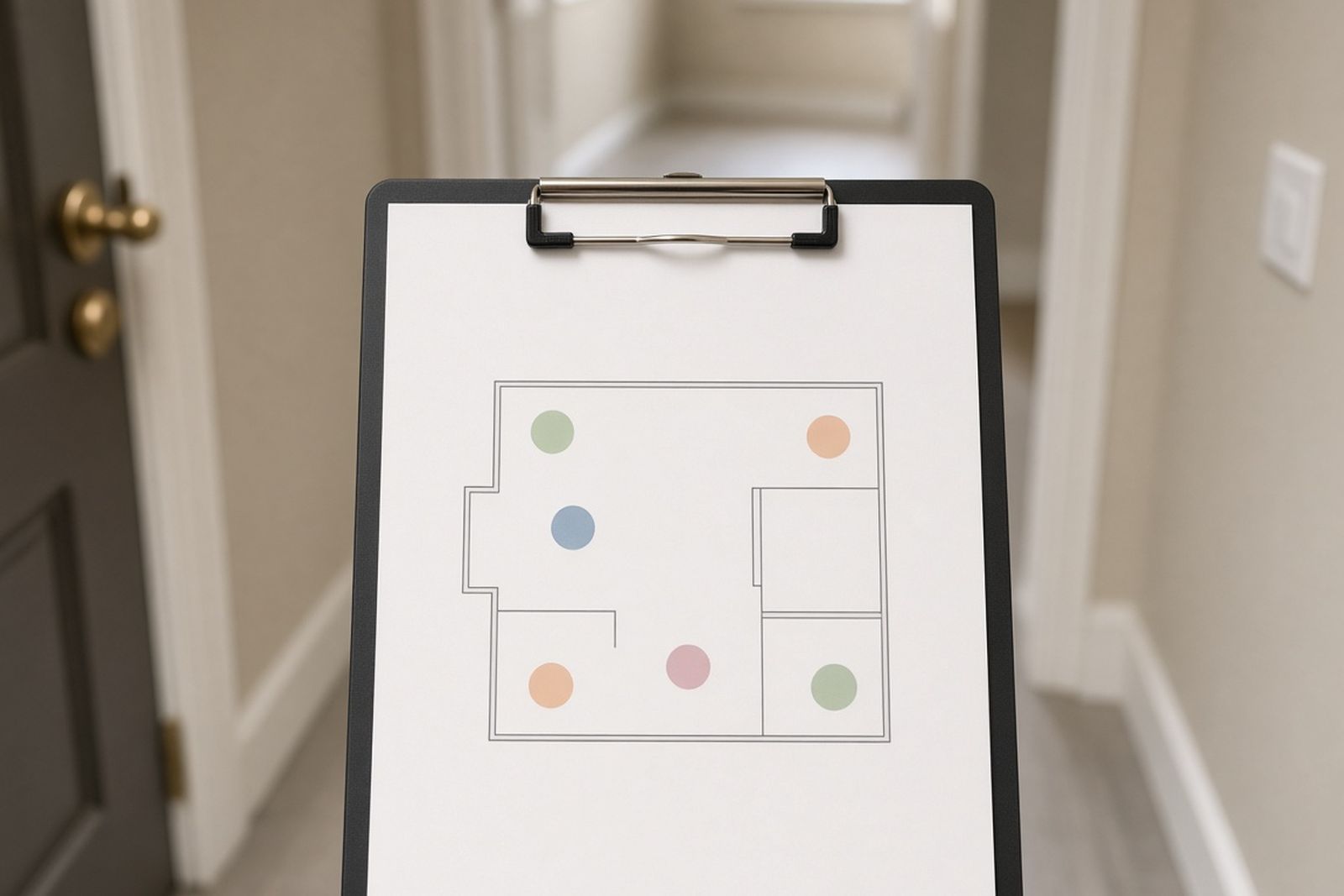
The walkthrough reveals a carpeted bedroom, a tiled bathroom with a fabric shower curtain, a cloth recliner, and wooden stair rails the father used to reach the upstairs bathroom once. The technician maps each area as high, moderate, or low priority based on how much contact the father had with it.
- High priority: bathroom fixtures, toilet, grab bars, bedside commode, bedroom nightstand, light switches and door levers along his route
- Moderate priority: living room recliner, TV remote, kitchen chair he used, stair rail
- Low priority: upstairs bedrooms he never entered, garage, basement
Product choice and contact time
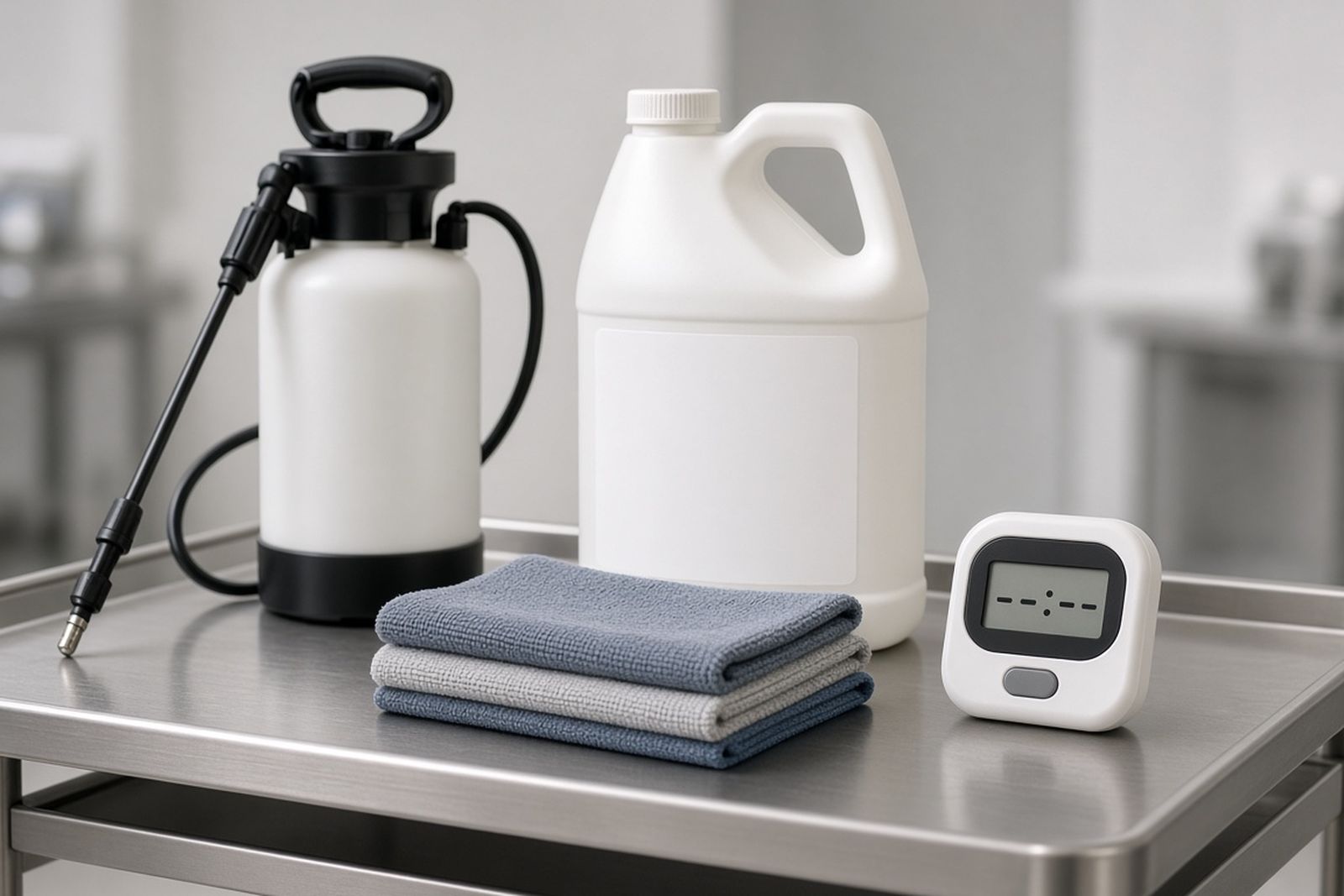
Because the organism is C. difficile, the scope specifies a product registered with a claim against C. difficile spores. The scope lists the product name, its EPA registration number, and the contact time stated on the label for that claim.
The technician explains that the surface has to stay visibly wet for that full time. On vertical surfaces and in warm rooms, that often means reapplying. The provider's crew uses a timer rather than estimating, and they note the start and finish time for each room in their log.
For surfaces that could be damaged by a sporicidal product, such as a finished wood nightstand or electronic remote, the scope names an alternative approach, such as wiping with a compatible registered product with the same claim, or setting the item aside for replacement if the family prefers.
Cleaning, disinfection, and soft items
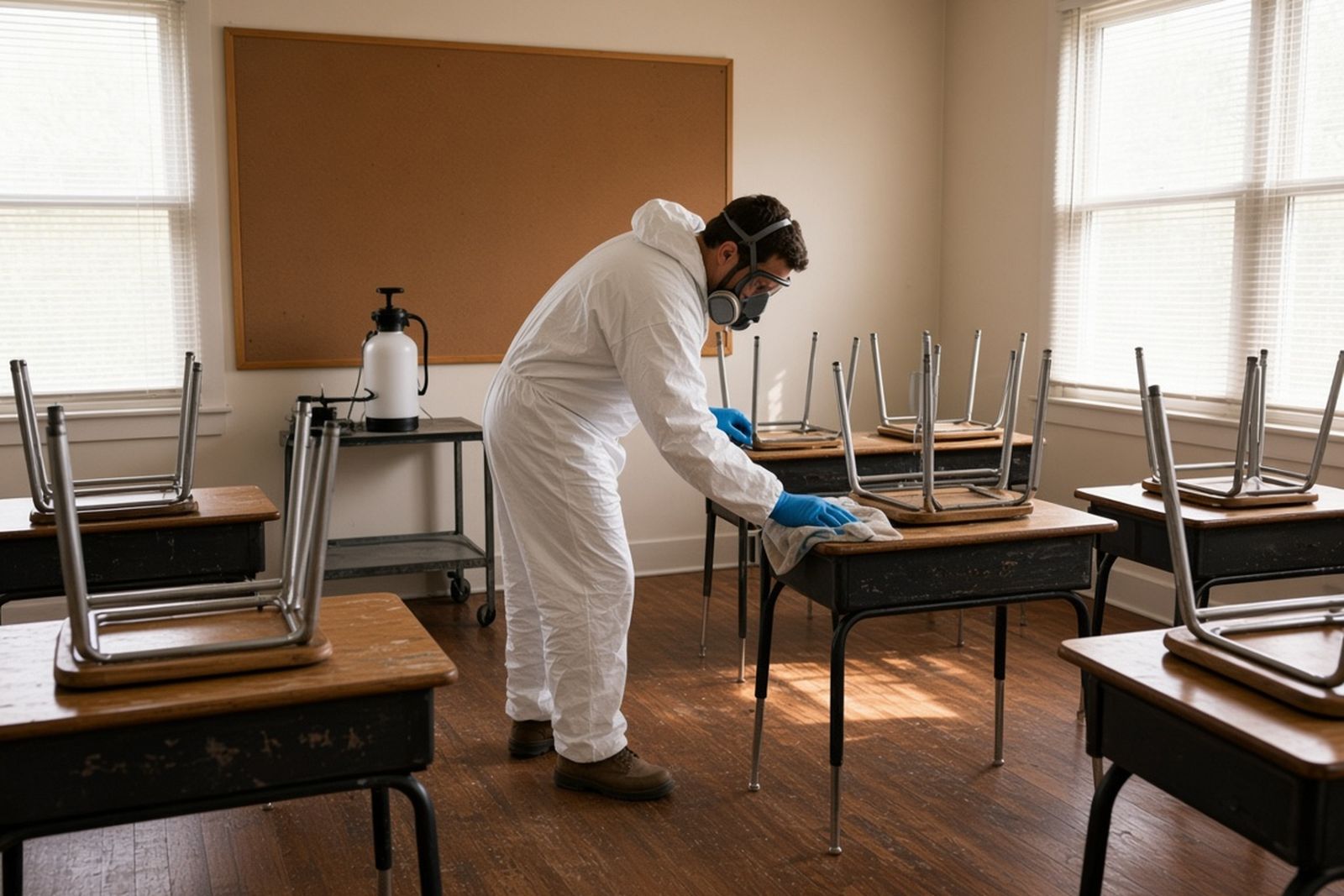
Every surface is cleaned first to remove soil, because organic residue can shield spores and weaken some disinfectants. Then the disinfection step follows with the chosen product and its full contact time. The scope shows these as two separate lines so the homeowner can see both were done.
Soft items get their own section. Bedding, towels, and the fabric shower curtain are laundered on the hottest setting their care labels allow and dried completely, or replaced. The carpet in the bedroom is cleaned by hot water extraction and treated according to the product label, with the provider noting that fabric treatment results are less certain than hard-surface results.
The recliner: the hardest call
The cloth recliner is the hardest call. The provider explains that upholstered furniture cannot be disinfected with the same confidence as a hard surface. The family can choose to have it cleaned and treated, knowing the limits, or replace it. They choose replacement, and the scope records that decision and the reason.
Moderate and low priority areas
Not every room gets the same treatment, and a good scope says so openly. In this example, the living room recliner, remote, kitchen chair, and stair rail are cleaned and disinfected with the same sporicidal product, but the crew does not treat walls, ceilings, or cabinets in those rooms, because the father had little contact with them.
The upstairs bedrooms, which he never entered, are left out entirely. The provider explains that treating them would add cost without meaningfully lowering risk. The daughter agrees, and the scope records the exclusion along with the reason.
This tiered approach is what separates a thoughtful plan from a blanket one. Spraying every surface in a house can feel reassuring, but it exposes the family to more chemical residue, can damage finishes, and spends money on areas that were never part of the problem. Aiming effort where contact actually happened is both safer and easier to defend.
Updating the scope as information changes
If new information comes up, such as the grandson mentioning that his grandfather often sat at the dining table to take his medications, the provider adds the table and chairs and notes the change. A scope is a living document until the work is finished.
Protections for the family and the crew
The scope explains that the father and grandson will stay out of the treated rooms during work and until surfaces are dry and any odor has cleared. Windows are opened where possible, and the crew does not use any fogging method, because hard-surface wiping with the right product fits this situation better.
Technicians wear gloves, gowns, and eye protection, and they change gloves between rooms to avoid carrying spores from the bathroom into the living room. Used wipes, gloves, and disposable covers are bagged and removed according to local rules.
The provider also leaves the family with a short list of ongoing habits: washing hands with soap and water rather than relying on alcohol sanitizer, which does not kill spores; keeping the father's bathroom separate for a while if possible; and asking his doctor how long those precautions should last.
The closeout packet
At the end, the daughter receives a packet she can keep. It lists every room and surface treated, the product used and its registration number, the contact time observed, who performed the work, and the date. It notes which items were laundered, cleaned, or discarded, and why.
The packet also records what was not treated, such as the upstairs bedrooms, so there is no confusion later. If the father has a recurrence, his doctor and the family can see exactly what was done and when.
The provider does not claim the house is sterile or guaranteed free of C. diff. Instead, the report describes what was done and what limits remain, which is more honest and more useful.
What can you apply from this example to your own situation?
Whatever the illness, the same questions help you judge a proposal. You want to know the organism the plan targets, why each area was prioritized, which product will be used and for how long, and what happens with the things that cannot be wiped.
If the provider cannot answer those questions clearly, the price per square foot does not tell you much. If they can, you have a plan you can check and explain to others in your household.
If a household member is receiving home health care, or the illness is one your state treats as reportable, ask the home health agency or your county health department whether they have cleaning instructions of their own before you sign a scope.
- Start with the organism, then map where the sick person spent time.
- Check that the product label lists that organism and note its contact time.
- Keep cleaning and disinfection as separate steps.
- Decide in advance how soft furnishings will be handled.
- Keep vulnerable household members out until treated surfaces are dry.
- Ask for a closeout record that includes what was not treated.