Short answer
In outbreak response, cleaning removes soil, body fluids, and residue that protect germs, while disinfection uses an EPA-registered product with a claim for the target organism to inactivate what remains. Disinfection only works as labeled on a cleaned surface kept wet for the full contact time. Facilities that skip cleaning, rely on spraying alone, or wipe too soon get the look of disinfection without the result.
Why does the difference matter during an outbreak?
When illness spreads through a building, the pressure is to do something visible fast. Spraying disinfectant across a classroom or fogging a locker room feels decisive. But disinfection is only one half of the job. Without proper cleaning first, much of that effort is wasted.
Cleaning and disinfection work together. Cleaning physically removes soil, body fluids, oils, and residue. Disinfection chemically inactivates organisms that remain on the cleaned surface. Each step supports the other, and the order matters.
Understanding the difference helps facility managers ask better questions of staff and vendors, choose appropriate products, and explain the response to leadership, families, and inspectors.
The distinction also affects cost and scheduling. A vendor who quotes only disinfection may appear faster and cheaper than one who includes cleaning, but the comparison is misleading. Knowing what each step accomplishes lets you compare proposals on what they actually deliver rather than on how quickly the crew can leave.
What the cleaning step does
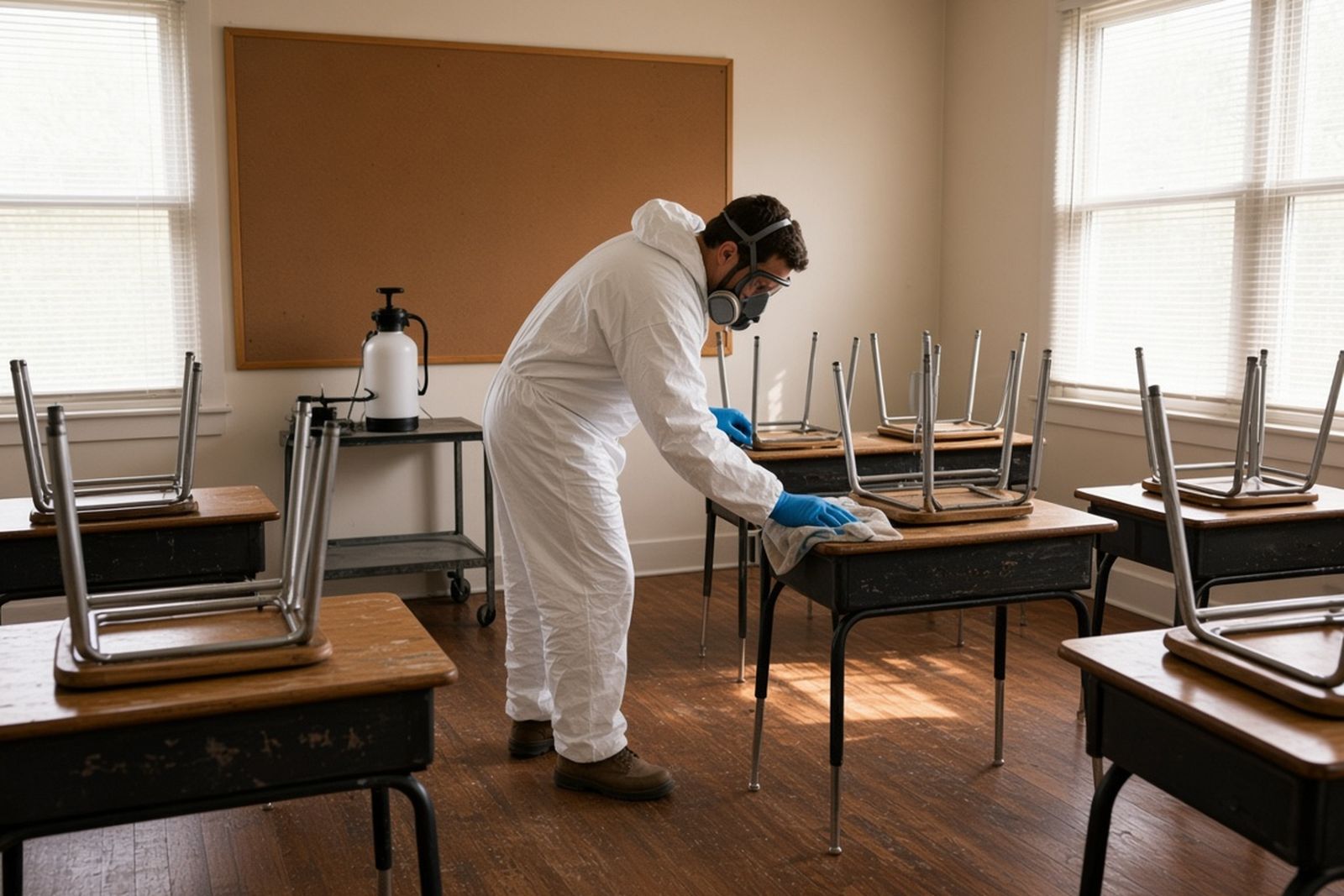
Cleaning uses detergent or a cleaning solution, water, and friction to lift contamination from a surface. It removes visible soil as well as invisible films of body oils, food residue, and dried fluids. Cleaning alone can remove a large share of microbes from a surface simply by carrying them away.
Just as importantly, cleaning prepares the surface for disinfection. Organic matter can shield organisms from a disinfectant and, for some chemistries, react with the active ingredient and reduce its effectiveness. A disinfectant applied over a sticky desk or a residue-coated faucet handle may never reach the organisms beneath.
In an outbreak, cleaning is also the step that deals with the most obvious hazards, such as vomit in a hallway or a soiled restroom stall. Those areas need careful removal of material before anything else happens.
Tools that don't spread contamination
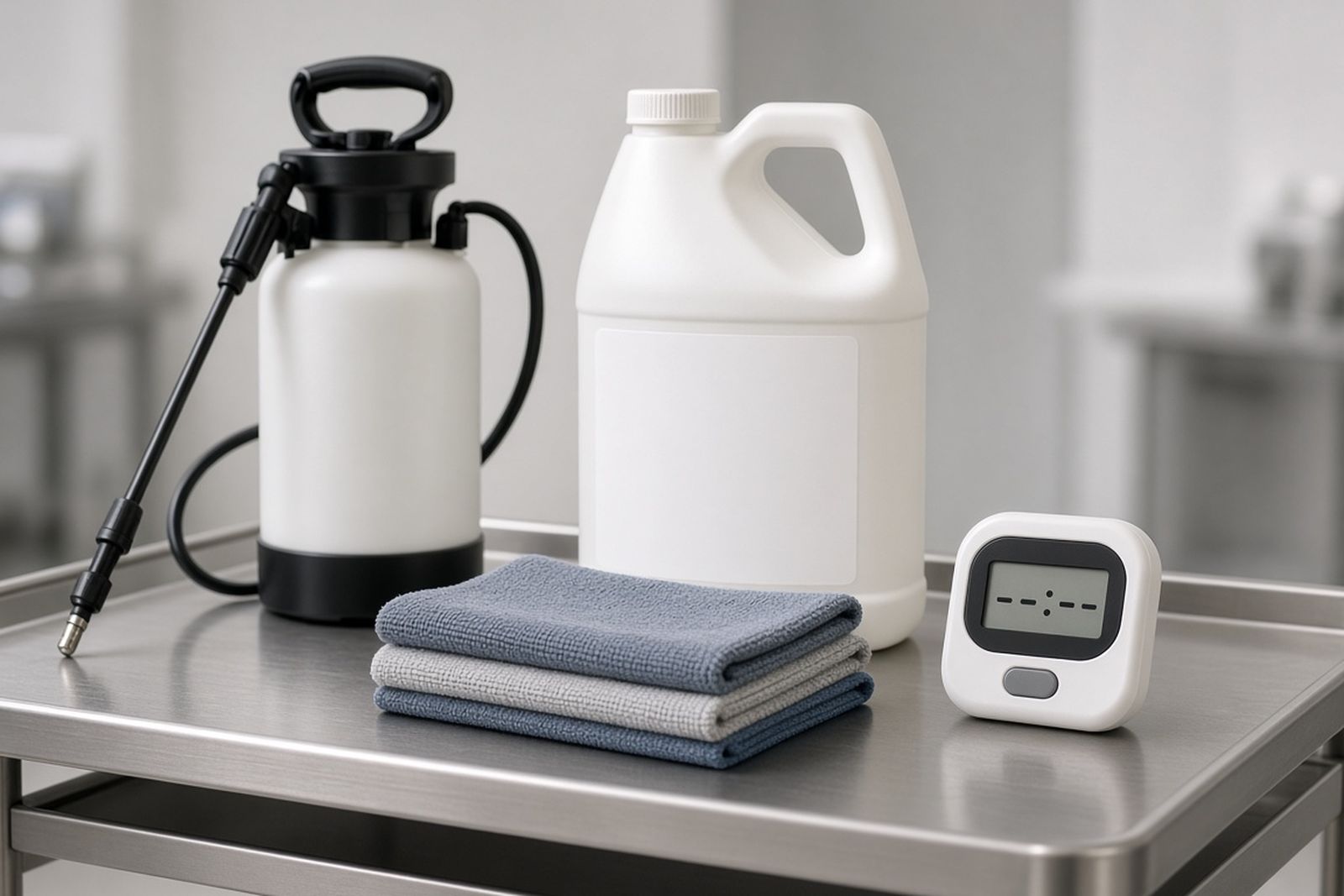
Cleaning tools matter as well. Reusing the same cloth across many surfaces can move organisms from one desk to the next instead of removing them. Color-coded microfiber cloths, frequent changes of cleaning solution, and working from cleaner areas toward dirtier ones help keep cleaning from becoming a way of spreading contamination.
What disinfection adds
Disinfection uses a registered antimicrobial product to inactivate specific organisms on a surface. The label tells you which organisms the product has been tested against, how to dilute it, which surfaces it can be used on, and how long the surface must stay wet.
For outbreak response, the organism matters. A product that works well against influenza may not carry a claim against norovirus, and only certain products are registered against C. difficile spores. Choosing a disinfectant with a label claim for the organism involved is one of the most important decisions in the response.
Some products are sold as one-step cleaner-disinfectants. Their labels usually allow a single application on lightly soiled surfaces, but often require a separate cleaning step when surfaces are heavily soiled. During an outbreak, many surfaces fall into that heavily soiled category, especially restrooms and areas where someone was ill. Reading the label for pre-cleaning instructions prevents a one-step product from being used as a shortcut it was never meant to be.
Using household bleach correctly
Household bleach remains a common option when used correctly. CDC advised in 2024 mixing 5 tablespoons (1/3 cup) of bleach per gallon of water, leaving it on surfaces at least 1 minute, and making a fresh solution daily because it loses effectiveness after 24 hours. Stronger solutions and longer contact times are recommended for certain organisms, such as norovirus.
What is contact time and why is it so often missed?
Contact time, sometimes called dwell time, is the period a disinfectant must remain visibly wet on a surface to achieve the kill claims on its label. If the surface dries or is wiped too soon, the label claim no longer applies.
Contact time is easy to miss in practice. Staff under time pressure may spray and wipe in one motion. Large surfaces, vertical surfaces, and warm rooms dry quickly. Some products evaporate faster than others.
Professional crews handle this by choosing products whose contact times fit the workflow, applying enough product to keep surfaces wet, reapplying when needed, and checking dwell times on large jobs. Facility staff can do the same by posting contact times near cleaning supplies and training people to wait before wiping.
Contact time also shapes product choice for different rooms. A product with a very short dwell time may suit a busy front desk that needs to reopen quickly, while a longer-dwell product with a broader claim may be appropriate for a restroom after a gastrointestinal outbreak.
Biofilms: why scrubbing still matters
Biofilms are communities of microorganisms that attach to surfaces and surround themselves with a protective matrix. They are common in wet environments such as drains, showers, and plumbing, but they can also form on dry surfaces that are touched and cleaned repeatedly without being fully cleaned.
Awareness of dry-surface biofilms is still limited. In a 2024 survey by Centeleghe and colleagues, 87.6% of healthcare professionals had heard of biofilms, but only 39.1% knew of dry-surface biofilms. If healthcare professionals are often unaware of them, it is safe to assume many facility staff are too.
Biofilms are relevant because they resist disinfectants more than free-floating organisms do. Mechanical cleaning, meaning actual scrubbing with friction, helps disrupt them. Spraying disinfectant alone is less likely to reach organisms protected inside a biofilm.
Where spraying and fogging fit
Foggers, electrostatic sprayers, and misting devices can deliver disinfectant quickly to large areas and hard-to-reach surfaces. They are disinfection tools, not cleaning tools. They do not remove soil, residue, or biofilm.
Used after proper cleaning, and with products labeled for that application method, spray technologies can supplement a response. Used as a replacement for cleaning, they tend to disinfect the top layer of whatever is already on the surface.
When evaluating a vendor or planning an in-house response, ask how surfaces will be cleaned before any spray technology is used and whether the chosen product's label permits that method.
In practice: a clinic waiting room
As an illustration, suppose an outpatient clinic learns that several patients seen in the same waiting room over two days later tested positive for a contagious gastrointestinal illness. The clinic manager wants the room treated before the next morning.
A trained crew first removes trash, magazines, and toys that cannot be disinfected. They clean chair arms, seat surfaces, the check-in counter, door handles, the water dispenser, and restroom fixtures with detergent and water, paying attention to crevices where residue collects. They rinse where the label requires it.
Next, they apply a disinfectant carrying a claim for the suspected organism and keep each surface wet for the labeled contact time, reapplying on vertical surfaces as needed. After hand disinfection of high-touch points, they use an electrostatic sprayer with a compatible product on chair backs and lower surfaces. They ventilate the room, then provide the manager with a report listing products, contact times, and areas treated.
The process takes longer than fogging alone, but it addresses both cleaning and disinfection and gives the clinic a clear record of the response.
A cleaning and disinfection checklist
Whether your own staff or an outside vendor performs the work, a simple checklist helps make sure both steps happen in order.
Adapt the list to your building and the organism involved, and keep completed checklists with your outbreak records.
- Confirm the organism, if known, and choose a disinfectant with a matching label claim
- Put on appropriate gloves, eye protection, and other protective equipment
- Remove visible body fluids and soil with disposable materials
- Clean surfaces with detergent and friction, starting with the least soiled areas
- Rinse if the disinfectant label requires a clean, residue-free surface
- Apply disinfectant and keep surfaces wet for the full labeled contact time
- Focus on high-touch surfaces and shared equipment
- Ventilate and follow label reentry guidance
- Document products, contact times, areas treated, and who performed the work
How do you explain the difference to staff and leadership?
Simple analogies help. Cleaning is like washing dishes; disinfecting is like running them through a sanitizing rinse. Skip the washing, and the sanitizing rinse cannot do its job.
Emphasize that a strong smell or a visible mist is not proof of disinfection. What matters is whether surfaces were cleaned first, whether the product fits the organism, and whether contact time was met. Encouraging staff to wait before wiping can do as much good as buying a new product.
Finally, remind everyone that surface work is only one part of outbreak control. Handwashing, staying home when sick, ventilation, and guidance from your local health department all matter too. Your county health department can tell you about any outbreak response requirements specific to your type of facility.