Short answer
To evaluate disinfection technology, ask which organism it targets, what independent evidence supports it under realistic conditions, whether surfaces must be cleaned first, what the re-entry time is, and what it cannot reach. Electrostatic sprayers, UV-C, and vapor systems can supplement manual cleaning in the right setting, but none replaces cleaning, correct product claims, and contact time. Air filtration addresses a different route of spread.
Why the market filled with new devices
The pandemic pushed disinfection into public view. Businesses wanted visible proof that spaces were safe, and manufacturers responded with sprayers, robots, lamps, and air devices.
Some of this technology came from hospitals, where it has been studied for years. Some was adapted quickly for offices, gyms, and schools with less evidence behind it. Marketing often blurred the difference.
The result is a crowded field. As a homeowner, facility manager, or business owner, your job is not to master every device but to know which questions separate a useful tool from an expensive distraction.
The baseline every technology should beat
The baseline is manual cleaning followed by wiping with an EPA-registered disinfectant whose label lists the organism of concern, kept wet for the labeled contact time. That approach has decades of evidence behind it. Any new tool should be judged by whether it improves on that baseline in your setting, fills a gap it leaves, or simply adds cost.
Most technologies are best understood as additions, not replacements. They can help reach complex surfaces faster, treat rooms between manual cleanings, or reduce human error in coverage. They rarely remove soil, and soil is what shields germs from disinfectants.
- Which organisms does it claim to address, and is that claim registered or independently tested?
- Does it require surfaces to be cleaned first?
- What contact time or exposure time is needed, and can your space accommodate it?
- What does it miss: shadows, soft surfaces, crevices, air?
- What are the risks to people, pets, materials, and electronics?
Electrostatic sprayers
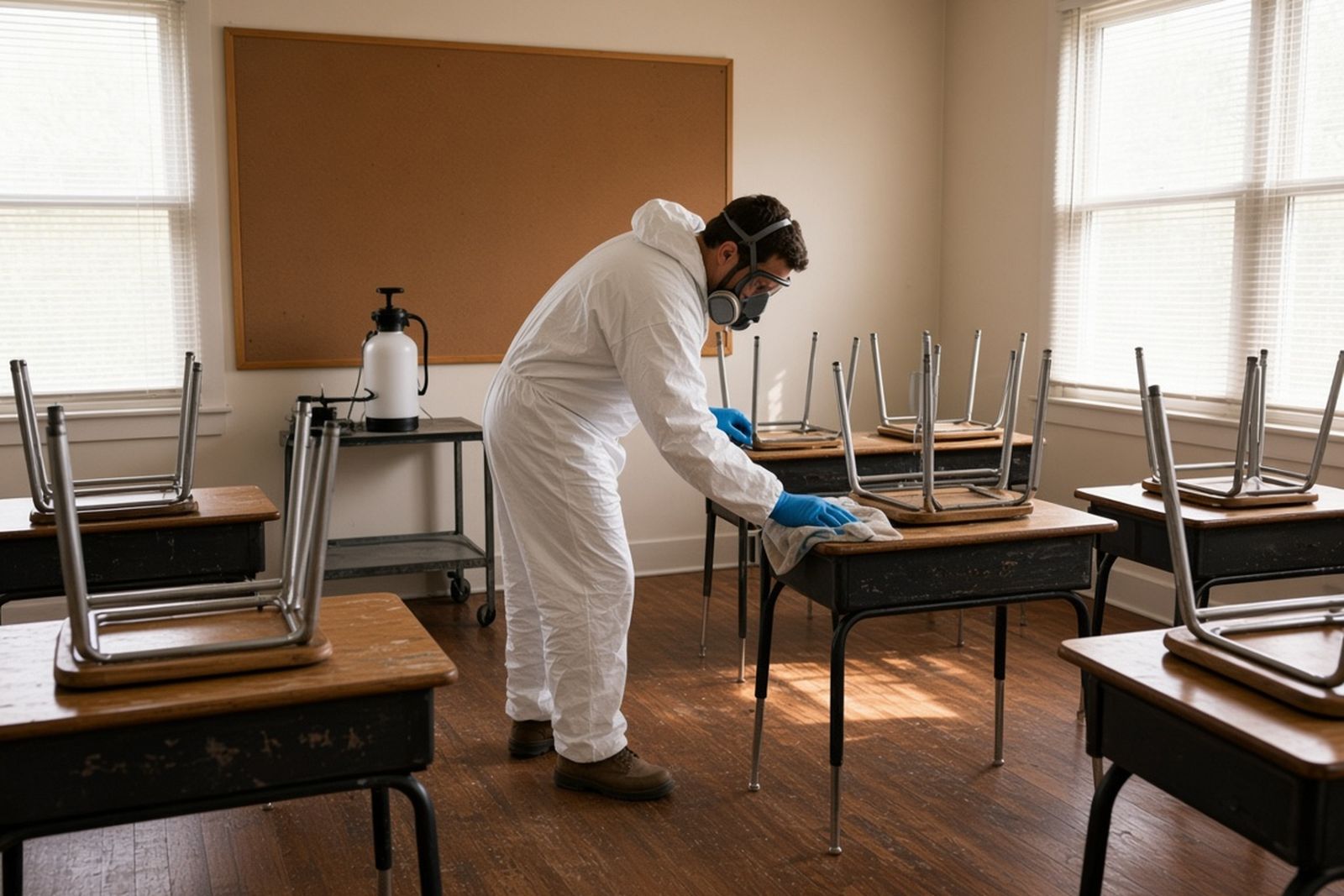
Electrostatic sprayers put an electric charge on droplets of disinfectant as they leave the nozzle. The charged droplets are attracted to surfaces and wrap around objects, reaching the backs and sides of chairs, equipment, and railings more evenly than a standard spray bottle.
Evidence suggests they can be efficient in the right conditions. Testing reported by Cadnum and colleagues in the American Journal of Infection Control in 2020 showed that an electrostatic sprayer applying 0.25% sodium hypochlorite cut C. difficile spores by 6 log10 or more with a 5-minute contact time, and treated a 15-20 chair waiting room in about 5 minutes.
The caveats are important. That result depended on a specific product, concentration, and contact time. The product you use must be registered for electrostatic application, surfaces must stay wet for the full labeled time, and heavily soiled surfaces still need cleaning first. Workers and occupants also need protection from inhaling fine droplets.
Ask the provider what product goes in the tank, and look up its label. Some products are registered for electrostatic use only on certain surfaces or only against certain organisms. A sprayer filled with a product that has no claim against your organism of concern is a fast way to apply the wrong chemical.
The limits of UV-C devices and robots
UV-C devices range from handheld wands to wheeled robots that sit in a room for a set cycle. They work by damaging the genetic material of microbes exposed to the light. They add no chemical residue, which appeals to many facilities.
Their reach is limited to surfaces in direct line of sight at a sufficient dose. Shadows, distance, angles, and soil all reduce effect. When Knobling and colleagues compared methods in 2023, pre-soaked manual wipes met their success criterion on 98.1% of surfaces, while UV-C used without prior cleaning managed 75.5%.
UV-C is also hazardous to eyes and skin, so rooms must be empty during cycles. It makes most sense in healthcare settings with trained staff and as a final step after manual cleaning. Handheld consumer wands with vague claims deserve particular skepticism.
Hydrogen peroxide vapor and other room systems
Some systems fill a sealed room with hydrogen peroxide vapor or a fine mist of peroxide-based product. These whole-room systems are used in hospitals, especially after patients with resistant organisms or C. difficile, because the vapor can reach surfaces that are hard to wipe.
They require careful sealing of the room, trained operators, monitoring to ensure the vapor has broken down before re-entry, and time. They are rarely practical for homes or ordinary offices. If a provider proposes one for a residential job, ask why a targeted manual approach would not work, and how they will seal the space and confirm safe levels before you return.
These systems also tend to be expensive per room, both in equipment and in the hours a space must stay closed. For a hospital unit battling a resistant organism, that trade-off can make sense. For a household recovering from the flu, it almost never does.
Do air purifiers and ventilation upgrades count as disinfection?
Air and surfaces are different routes of spread. Respiratory viruses such as influenza and the virus that causes COVID travel mainly through the air, though they also land on surfaces. Norovirus and C. difficile spread mostly through contact and contaminated surfaces.
Portable HEPA air cleaners, improved HVAC filtration, and increased outdoor air can lower the concentration of airborne particles. Upper-room UV-C fixtures, installed high on walls with shielding, can treat air circulating near the ceiling. These are well-established approaches for respiratory illness in occupied spaces.
Other air devices, such as ionizers and some plasma or photocatalytic products, have more mixed evidence, and some can produce byproducts like ozone. If you are considering an air device, ask for independent testing in real rooms, not only in sealed test chambers, and whether it produces any ozone.
Check the system you already have
A simple, inexpensive step many buildings overlook is checking that existing HVAC systems are running as designed, with filters changed on schedule and outdoor air dampers open. Fixing a neglected system often delivers more benefit than adding a new device.
A gym weighing two proposals
An illustrative case: a neighborhood gym has had a run of member complaints about skin infections, and staff suspect MRSA. The owner receives two proposals.
The first proposes nightly UV-C robot cycles in the main workout floor and a monthly fogging service. It does not mention cleaning or specific organisms. The second proposes daily cleaning of mats, benches, and equipment grips with detergent, followed by wiping with a product that carries an MRSA claim at its labeled contact time, electrostatic application weekly for equipment with complex shapes, and a laundry protocol for towels.
The owner asks the first vendor how the robot will reach the underside of bench pads and the knurled grips of dumbbells. The answer is unclear. The owner chooses the second plan, adds wipe stations for members, and asks members with open wounds to cover them. The gym's local health department is available for questions if complaints continue.
How do you check vendor claims before you buy?
Start with registration. Any product sold as a disinfectant in the United States must be registered with EPA, and its label will list approved organisms and application methods. Devices that do not use chemicals are regulated differently, so their claims deserve closer scrutiny.
Ask for evidence that matches your conditions. A lab test in a clean chamber, with a single organism on a smooth surface, is a starting point. A study in a real room with real soil and furniture is more meaningful. Be cautious about claims like kills 99.9% of all germs without specifics about which germs, what surface, and how long.
Ask for references from similar settings. A vendor that has installed a device in several schools or clinics should be able to connect you with a facility manager who can describe what changed, how staff adapted, and whether maintenance or replacement parts turned out to be costlier than expected.
In healthcare, childcare, and food settings, check with your licensing agency or health inspector before adopting a new method, since specific methods may be required or restricted there.
The practical takeaway
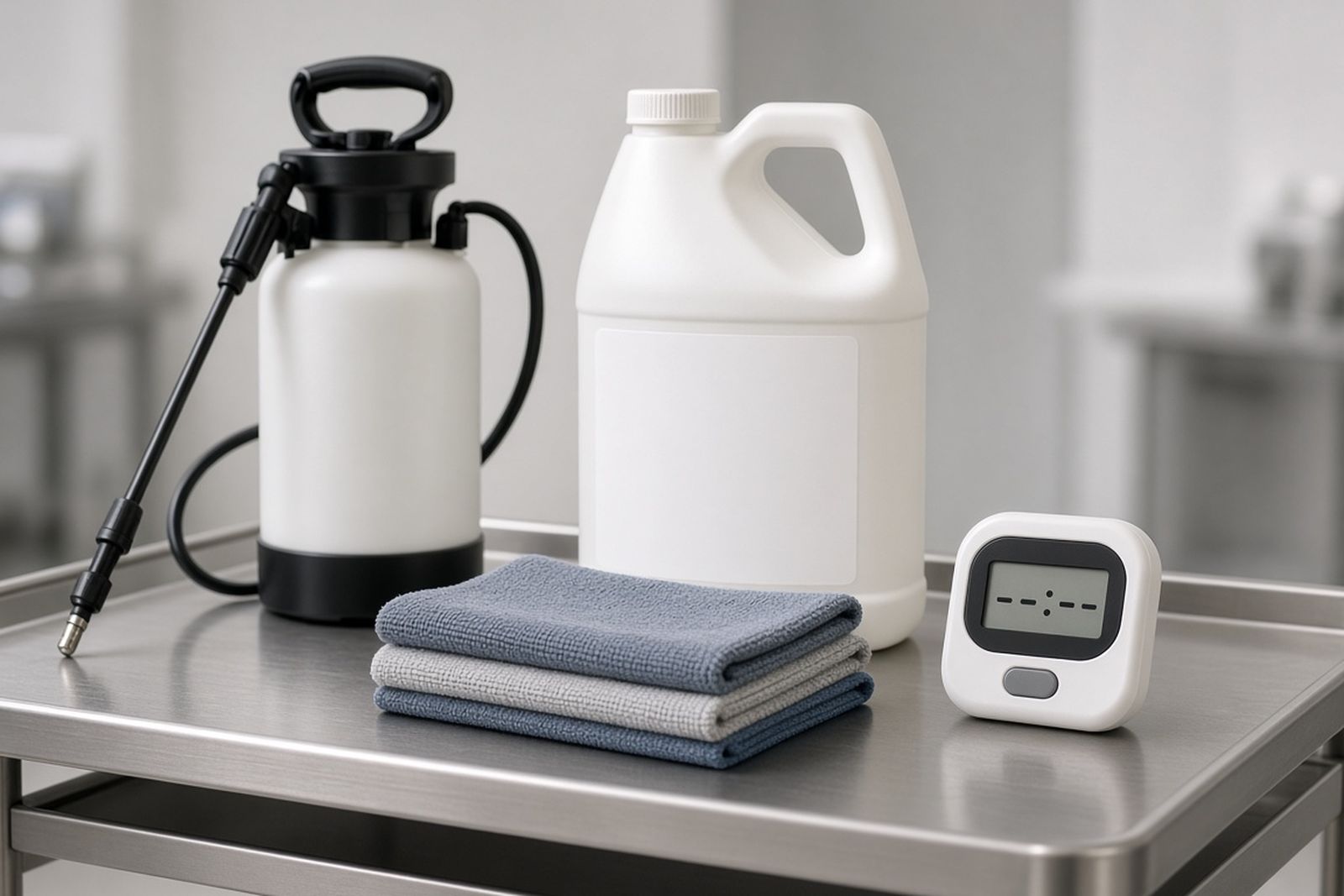
For most homes, the best technology is a product with the right label claim, a clean cloth, a timer, and an open window. Advanced devices seldom add much to a single sick household.
For larger facilities, technology can add real value when it is matched to a specific problem and paired with manual cleaning. Electrostatic sprayers for complex equipment, upper-room UV or better filtration for respiratory illness, and whole-room systems in high-risk healthcare areas all have their places.
Train the people who will use the tools. A sprayer or UV device in untrained hands can create false confidence, miss surfaces, or put staff at risk. Short, hands-on training with the manufacturer's guidance and the product label usually pays for itself quickly.
Whatever you choose, keep a record of what was used, where, and when. That habit lets you see whether a new tool is making a difference, and gives public health staff useful information if an outbreak continues.
Sources
- American Journal of Infection Control (Cadnum et al.) — Evaluation of an electrostatic spray disinfectant technology for rapid decontamination of portable equipment and large open areas in the era of SARS-CoV-2
- Knobling et al. — Superiority of manual disinfection using pre-soaked wipes over automatic UV-C without prior cleaning