Short answer
To evaluate equipment proposed for infectious disease disinfection, check that each disinfectant is EPA-registered for the organism and the application method, that the device supports rather than replaces cleaning, that the labeled contact time can be met, and that re-entry and respiratory safety are addressed. Ask for independent field evidence, material compatibility, and a clear plan to verify results.
Why equipment has become so hard to evaluate
Since the pandemic, the market for disinfection tools has grown quickly. Offices, schools, clinics, gyms, and care facilities now receive proposals for electrostatic sprayers, foggers, ultraviolet robots, hydrogen peroxide vapor systems, and a long list of chemical products, each promising faster or more complete results.
Many of those tools have legitimate uses. Some are poorly matched to the spaces they are sold for, and a few are marketed with claims that go beyond the evidence. The challenge for you is sorting out which is which without becoming an expert in microbiology.
The good news is that most of the evaluation comes down to a short list of questions about registration, application method, contact time, safety, and verification.
It also helps to remember what you are trying to accomplish. The goal is to reduce infectious organisms on surfaces people touch. Any piece of equipment should be judged by how well it helps you do that, not by how advanced it looks.
Start with the disinfectant itself
Every tool is only as good as the product it delivers. A disinfectant must be registered with EPA before it can be sold, but registration covers a wide range of products with very different claims, so you need to look at the specific product, not just the category.
Ask for the EPA registration number of each product in the proposal. Then read the label. Check which organisms it covers, which surfaces it is approved for, what contact time it requires, and which application methods are permitted. A product approved for wiping is not automatically approved for spraying or fogging.
Match the claim to your concern. If you are responding to norovirus, the product needs a norovirus claim. For C. difficile, it needs a sporicidal claim. A general claim against bacteria and enveloped viruses will not cover those tougher organisms.
Finally, check the safety data sheet. It tells you what protective equipment is needed and whether the product could irritate the eyes, skin, or lungs.
Evaluating electrostatic sprayers
Electrostatic sprayers give droplets a charge so they are attracted to surfaces and wrap around objects. They can cover large areas and complex shapes efficiently, which makes them attractive for classrooms, waiting rooms, and gyms.
When reviewing a proposal, ask whether the product is registered for electrostatic application and whether the sprayer delivers enough liquid to keep surfaces wet for the labeled contact time. A fine mist that dries in seconds may not meet the label.
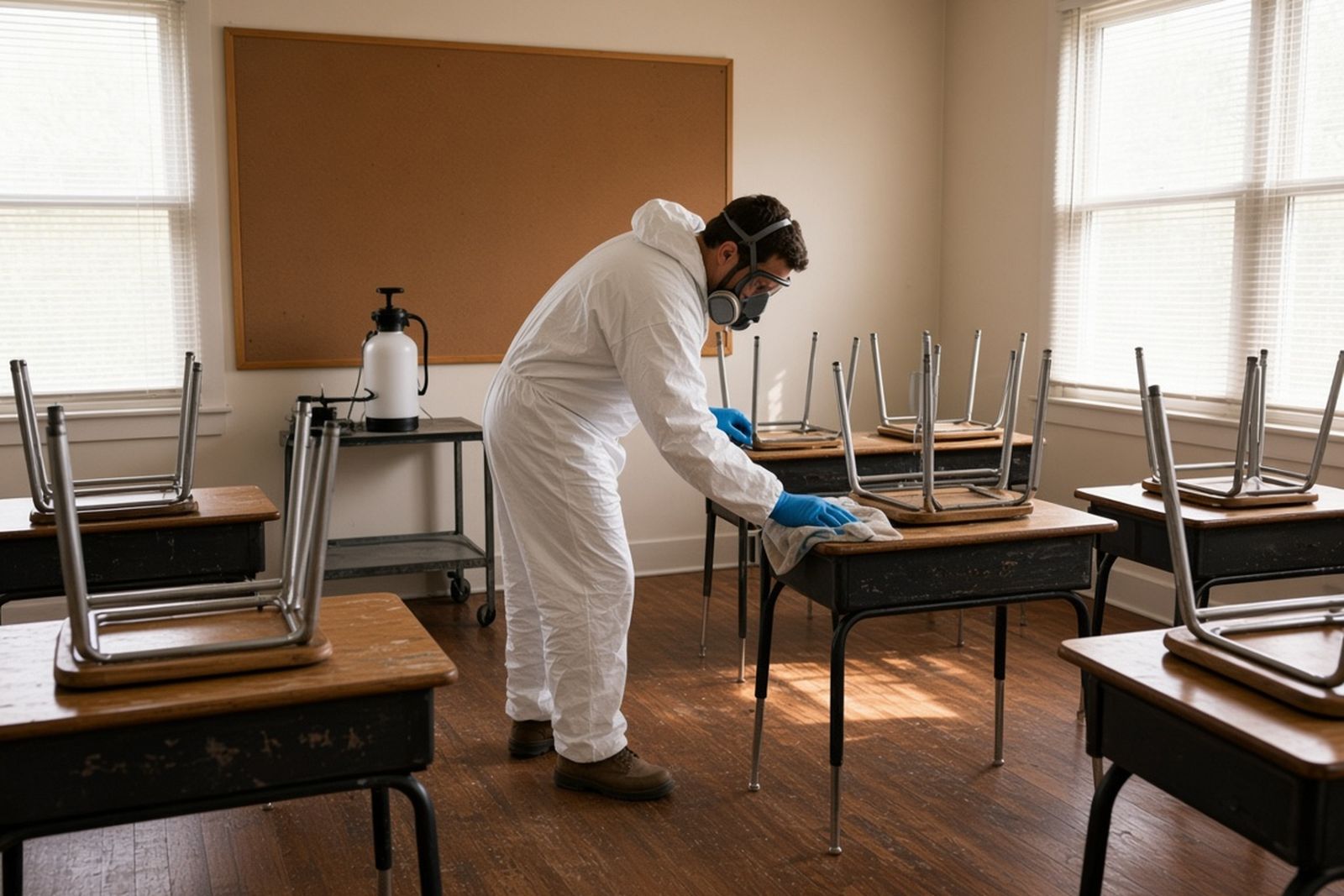
Ask about pre-cleaning. Surfaces with visible soil need cleaning first, and sprayers do not remove grime. Ask, too, what protective equipment operators wear and whether the space must be empty during application.
Consider the surfaces involved. Electronics, fabrics, and some finishes may react poorly to repeated spraying, so a good provider will cover or avoid sensitive items.
Maintenance matters more than most buyers expect. Nozzles clog, batteries wear out, and residue builds up in tanks if they are not rinsed after use. Ask who will maintain the sprayers, how often, and what happens when one fails in the middle of an outbreak response. A backup plan, even if it is simply a supply of wipes and trained staff, keeps work from stalling.
UV-C devices and hydrogen peroxide vapor systems
UV-C devices use short-wavelength ultraviolet light to damage microbial genetic material. They are used in some hospitals for terminal room disinfection. They only affect surfaces in their line of sight, and shadowed areas, the undersides of objects, and soiled surfaces receive little benefit.
Evidence favors combining devices with manual work rather than replacing it. Knobling and colleagues reported in 2023 that manual wiping with pre-soaked wipes outperformed UV-C used without prior cleaning. That does not make UV-C useless, but it shows why it should follow cleaning, not substitute for it.
Hydrogen peroxide vapor and similar whole-room systems can reach many surfaces, including hidden ones, but they require sealing the room, removing people, and waiting through a cycle and aeration period. They are best suited to specific high-risk situations rather than routine use.
For any device, ask for field data in settings like yours, not just laboratory results on clean test surfaces.
How do you protect people from the equipment itself?
Disinfection can create its own health risks, particularly for the workers who apply products day after day and for building occupants with asthma or chemical sensitivities. Spraying and fogging put more product into the air than wiping does.
Any proposal that increases spraying should explain how operators and occupants will be protected, because the people applying the product breathe the most of it.
Ask about ventilation during and after application, re-entry intervals, and whether the product has any known respiratory hazards. Ask what respirators or masks operators wear and whether they are fit-tested.
For schools, childcare centers, and care facilities, consider whether a lower-risk method can achieve the same result. Wiping with a registered product is often just as effective and adds less to the air.
Everyday supplies a good proposal includes
Advanced devices get the attention, but everyday supplies do much of the work. A strong proposal will address them too.
Pay attention to how the proposal handles laundry. Bedding, towels, gowns, and cloth items from sick rooms spread organisms if they are shaken or carried loose. A good plan specifies closed bags, a route to the laundry area that avoids clean spaces, and wash settings suited to the fabric.
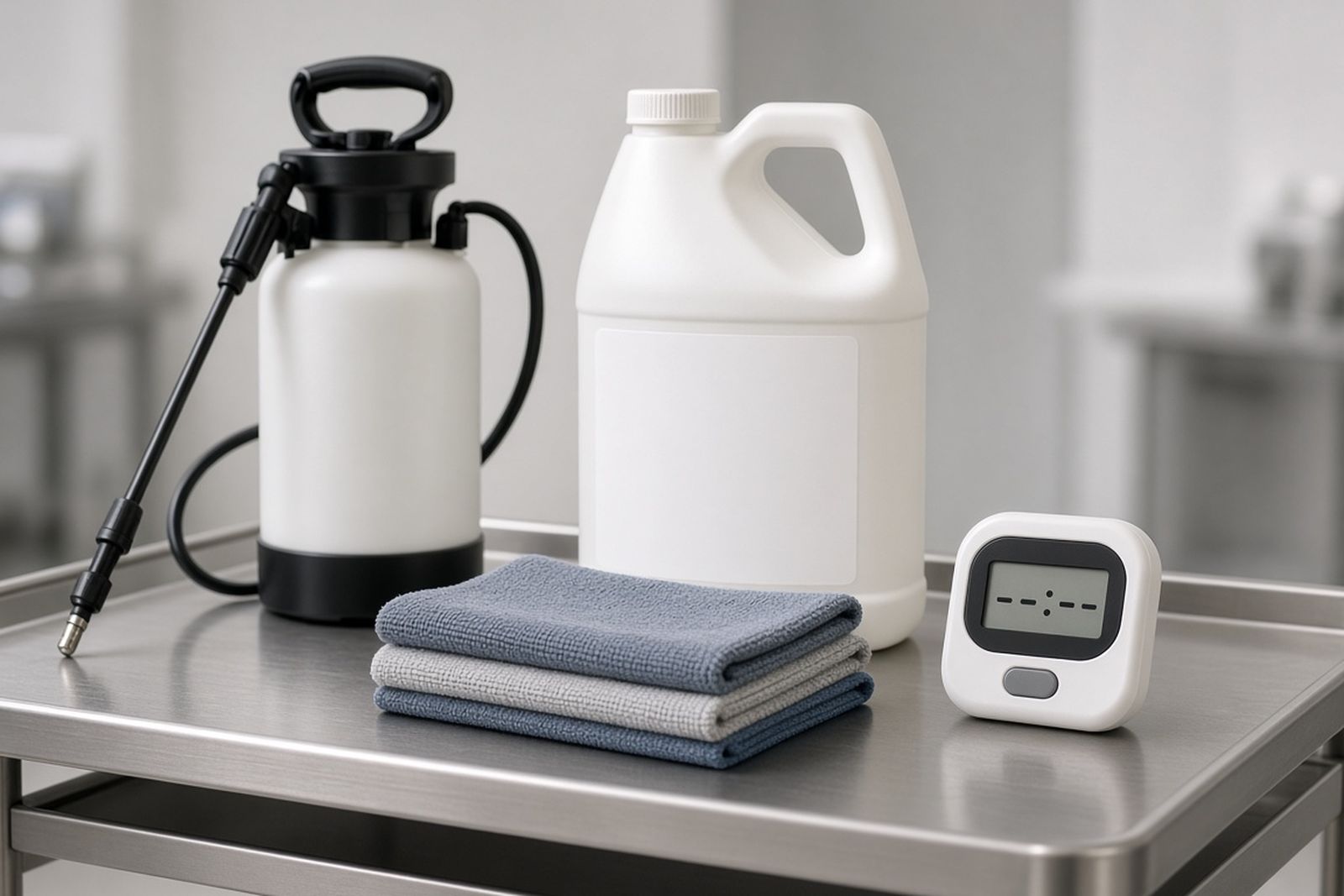
- Color-coded microfiber cloths and mop heads to prevent cross-contamination between areas
- Pre-saturated wipes or measured dilution systems to avoid mixing errors
- Timers or clear guidance to track contact time
- HEPA-filtered vacuums for soft surfaces and dust
- Bags and containers for laundry and waste
- Appropriate protective equipment for staff
- Signage to keep people out of treated areas until ready
A district weighing two proposals
One illustrative case: a school district is reviewing two proposals after a winter of heavy absenteeism from influenza and stomach illness. The first vendor offers portable UV-C towers for every classroom. The second offers electrostatic sprayers with a registered product that has norovirus and influenza claims, along with training for custodial staff on microfiber cleaning.
The district's facilities director and school nurse review both. The UV-C towers would require empty classrooms, could not reach inside desks or under tables, and came with no data from classroom settings. The sprayer product is registered for electrostatic use and lists a contact time that custodians can meet during evening cleaning. The proposal also addresses ventilation and re-entry.
The district chooses the second proposal but adds a requirement that custodians clean visibly dirty surfaces before spraying and wipe high-touch points by hand. It also asks the vendor to support a small pilot with ATP testing before and after, so the district has its own data.
Measuring results, then signing
Equipment claims are easiest to believe when you can verify them. ATP meters measure organic residue on a surface and give a quick reading of cleaning quality. Fluorescent markers show whether a surface was touched during cleaning. Microbial sampling is more precise but slower and more expensive.
Ask any provider how they will measure results in your space and what readings they consider acceptable. Build in a follow-up check after a few weeks to see whether results hold up.
If results are disappointing, look first at process: pre-cleaning, coverage, and contact time. Those are more often the problem than the device itself.
Share results with the people doing the work. Custodians and housekeepers who see their ATP readings improve tend to take pride in the process, and those who see gaps can correct them. Measurement works best as a coaching tool rather than a grading system.
Read the full proposal, not just the headline. Look for registration numbers, safety data sheets, application methods, contact times, re-entry intervals, and verification plans. Ask about maintenance, training, and the cost of consumables over time.
Be cautious about any claim that a device eliminates the need for cleaning or guarantees a space is free of germs. No credible provider should promise that.
Ask what the contract covers if an outbreak continues. Some providers price a single visit, while others offer a schedule of return visits or on-call support. Knowing which you are buying helps you plan staffing and budget for the weeks that follow.
In healthcare, childcare, education, and food service settings, ask your licensing agency or health department whether it sets cleaning and disinfection standards the equipment and products must meet.